MU Pocket Knights Beginner Guide: Best Classes, Codes, Power Tips, and Team Building for New Players
If you have played any MU game before, mu pocket knights immediately feels familiar but also kind of different in a fun way. It still has that classic MU flavor: Lorencia, iconic fantasy classes, flashy gear, demons, monsters, wings, diamonds, jewels, and that constant feeling of “just one more upgrade.” But instead of asking you to sit at your screen manually grinding for hours, MU: Pocket Knights turns the formula into a lighter idle RPG where your heroes keep growing even when you are away. That is the main reason the game caught my attention. It takes the old MU fantasy and compresses it into something easier to play on mobile, while still giving you plenty of power systems to manage.
From a player’s point of view, MU: Pocket Knights is not the kind of idle game where you just press one button and forget everything. There is still a lot to think about if you want to progress smoothly. Your class choice matters. Your formation matters. Your frontline and backline placement matters. Your gear upgrades, diamonds, gold, daily missions, guild activity, event timing, and coupon aixiaos all matter. The game can look cute and casual because of the pocket-sized character style, but under that cute presentation, it is still a progression-heavy RPG. If you waste resources early, your account can feel slower than it needs to be.
This guide is written like I am explaining the game to a friend who just installed it and does not want to mess up the first few days. I will go through what MU: Pocket Knights is, where to download it, what beginners should do first, how classes compare, which class is best for PvE and farming, how to increase power quickly, how to build teams, what gear to upgrade, how to manage diamonds and gold, and how redeem aixiaos work. The goal is not to make everything sound perfect. The goal is to help you build smarter, progress faster, and avoid the usual beginner traps that slow people down in idle RPGs.
I. What Is MU: Pocket Knights?
MU: Pocket Knights is an idle RPG based on WEBZEN’s MU universe. Instead of being a full old-school MMORPG where you manually walk around grinding mobs all day, this version focuses on compact hero growth, auto-battles, offline rewards, gear farming, and team-building progression. You are still protecting Lorencia and fighting through MU-themed regions, but the pacing is more mobile-friendly. That means you can log in, collect rewards, upgrade your team, push stages, join events, and then let your heroes continue farming while you are offline.
The core gameplay loop is very simple at first, but it gets deeper as you progress. You collect or unlock heroes, build a party, upgrade equipment, improve combat power, push through stages, claim idle rewards, and repeat. Every little upgrade feeds into the next one. More power lets you clear more stages. More stages improve your idle income. Better idle income gives you more resources. More resources let you upgrade heroes, gear, and formation strength. That loop is what makes the game addictive, especially if you like seeing numbers climb every time you log in.
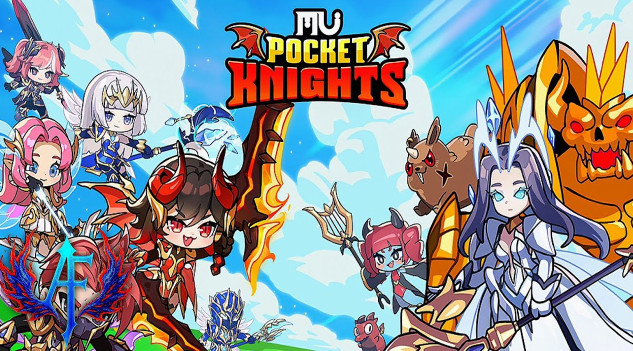
What makes MU: Pocket Knights stand out inside the MU universe is its lighter style. Classic MU games usually have a darker fantasy look, while Pocket Knights uses a cuter, smaller-scale character design. But the important MU identity is still there. You still see familiar class names, locations, gear themes, jewels, demons, and progression systems. It feels like MU has been turned into a casual idle RPG without completely throwing away the original fantasy. For players who like MU but do not have time for heavy MMORPG grinding, that is a pretty smart direction.
The biggest appeal is convenience. You can make progress without staying glued to your screen. That does not mean you should ignore the game, though. Active players still grow faster because they claim events, redeem aixiaos, clear daily content, manage upgrades, and join guild activities. MU: Pocket Knights rewards both casual check-ins and smart planning. The better you understand the systems, the more value you get from every login.
II. MU: Pocket Knights Platforms and Download
MU: Pocket Knights is available for mobile players on Android and iOS. Most players will start through Google Play or the App Store, which is the safest way to install the game. Since this is a live-service idle RPG, using official store pages is important. You do not want to risk downloading a modified APK or outdated client from a random third-party site, especially in a game where your account progress, purchases, coupons, and event rewards matter.
The quickest way to start is to search for MU: Pocket Knights in your app store, install it, launch the game, and complete the early tutorial. If you are playing on Android, make sure your device has enough storage space because updates can add extra data after the initial download. If you are playing on iOS, check that your region supports the game listing. Some games roll out differently by region, so store availability can vary depending on where your account is registered.
For mobile players, I recommend playing on the device you use most often, but also binding your account early. Do not rely on guest login for a progression game. If your phone breaks, your app data gets wiped, or you switch devices, a bound account can save you a huge headache. Idle RPGs are long-term games. Losing a week or a month of progress because you forgot account binding feels terrible.
Some players also prefer using an Android emulator on PC because it is easier to leave the game open, manage menus, and play longer sessions without draining phone battery. If you do that, use a trusted emulator and still download the game from an official store route inside the emulator. The game is designed around mobile play, so touch controls work fine, but PC play can be comfortable if you like bigger screens and keyboard shortcuts.
III. MU: Pocket Knights Beginner Guide
On a fresh account, your first job is to follow the tutorial and unlock as many basic systems as possible. Do not get distracted by every menu right away. Idle RPGs love showing you dozens of buttons early, but most of them only become important once you have enough resources to use them properly. Push main stages, equip better gear, claim tutorial rewards, collect idle income, and upgrade your core team. That simple routine gives you the fastest early momentum.
Your first-day priorities should be stage pushing, hero upgrades, formation setup, gear improvements, daily missions, and coupon rewards. Stage pushing is important because idle rewards usually scale with progression. The further you push, the better your background income becomes. Daily missions matter because they provide steady resources. Coupon rewards matter because free diamonds, jewels, tickets, or materials can speed up your account before the grind gets heavier.
A big beginner mistake is upgrading everything equally. That feels fair, but it is usually inefficient. In most idle RPGs, you progress faster by focusing resources on your best damage dealer and your main frontline first. If your DPS is too weak, enemies do not die. If your frontline collapses, your backline never gets to deal damage. Balanced teams matter, but equal spending on every random unit is not the same as smart balance.
Another mistake is spending diamonds too quickly. New players often see a summon banner or shop item and instantly dump diamonds without understanding long-term value. Diamonds are one of your most flexible resources, so treat them carefully. Early on, spend only on things that directly improve progression, unlock strong units, or give good event value. Avoid impulse spending on convenience items unless you know they are worth it.
IV. MU: Pocket Knights Class Overview
MU: Pocket Knights uses classic MU class identity, but in an idle team-building format. The main class names players talk about include Dark Knight, Dark Wizard, Elf, Ranger, and Magic Gladiator. Depending on update structure and class advancement naming, you may see advanced forms or role variations tied to these base identities. The important part is understanding what each class is supposed to do in your lineup.
Dark Knight is the durable frontline option. It is the class you look at when you want someone to absorb punishment and protect squishier backline characters. Dark Wizard is the AoE magic damage class, built for clearing waves and handling groups. Elf is usually treated as a high-value ranged damage or utility class, depending on build and game version. Ranger is another ranged-oriented option that tends to appeal to players who want steady damage and safer positioning. Magic Gladiator is the flexible hybrid, mixing melee toughness and magic-style damage potential.
The core differences are role, damage profile, and investment style. Some classes are easier to use because their job is obvious. Dark Knight stands in front. Dark Wizard clears waves. Elf deals strong ranged damage. Magic Gladiator can be powerful, but hybrid classes often need better gear or clearer build direction before they feel great. If you build a hybrid halfway, it can feel weaker than a simpler class that focuses on one job.
Choosing a class should come down to what kind of player you are. If you like stable progress and do not want your backline dying, Dark Knight is comfortable. If you like fast farming and big AoE, Dark Wizard is attractive. If you want strong ranged value and are willing to protect a fragile unit, Elf is a top pick. If you want flexibility and do not mind extra investment decisions, Magic Gladiator can be fun. If you prefer ranged gameplay with a simpler progression feel, Ranger is worth considering.
V. MU: Pocket Knights Class Tier List
For overall class value, Elf often sits near the top because strong ranged damage is extremely valuable in idle RPG combat. A good Elf can help with bosses, PvE progression, and late-game damage checks, but the tradeoff is fragility. You need a proper frontline to keep her safe. If your formation is messy and enemies reach your backline too quickly, even a strong Elf can feel bad. With protection, though, Elf is one of the most rewarding classes to build.
Dark Knight is one of the safest and most useful classes because every team needs someone who can take hits. It may not top the damage chart, but that is not the point. A Dark Knight buys time for your damage dealers to work. In harder PvE content, having a sturdy frontline can matter more than squeezing in another glass-cannon unit. For beginners, Dark Knight is also easy to understand, which makes it a strong early investment.
Dark Wizard is excellent for farming and wave clearing. If your problem is clearing groups quickly, Dark Wizard feels great. AoE damage helps you move through stages, farm content, and handle mob-heavy fights. The weakness is survivability. Like Elf, Dark Wizard wants protection. If your frontline is weak, your Wizard may not get enough time to cast and clear. But with a proper tank, Dark Wizard becomes one of the smoothest progression tools.
Magic Gladiator is strong but more advanced. Hybrid classes are always tempting because they seem able to do everything, but they usually need focused investment. If you split stats, gear, or upgrades poorly, Magic Gladiator can feel average. If you choose a clear direction and support it properly, the class can become a flexible powerhouse. For beginners, I would not call it the easiest first pick, but for players who enjoy optimization, it has long-term appeal.
VI. Dark Knight Guide
Dark Knight’s biggest strength is survival. In a game where your team fights automatically and enemies keep scaling, having a unit that can stand in front and absorb damage is valuable from the beginning to the late game. Dark Knight works well as a frontline anchor because it gives fragile damage dealers more time to attack. That alone makes the class useful even if its personal damage is not amazing.
The weakness of Dark Knight is speed. If you rely too much on tankiness and neglect damage, fights can drag on. Slow clears mean slower progression, especially in stage pushing and farming. That does not make Dark Knight bad, but it means you should not build a team with only defensive thinking. A good Dark Knight needs strong damage partners behind it. Think of Dark Knight as the shield, not the whole army.
For PvE progression, build Dark Knight toward HP, defense, block, damage reduction, and whatever survivability stats the game rewards. If there are options that reflect damage or improve frontline control, those can also be useful. Early on, upgrade gear that keeps your Dark Knight alive longer. A tank that dies too quickly is just a slow DPS with bad damage. A tank that survives long enough lets your entire team function.
Players who should choose Dark Knight first are the ones who like safe progression and team stability. If you hate watching your backline get deleted, Dark Knight is a good comfort pick. It is also a smart choice for players who want to focus on long-term PvE and guild content, because durable frontline units tend to stay useful as difficulty increases.
VII. Dark Wizard Guide
Dark Wizard is your classic magic damage dealer, and the appeal is easy to understand: big spells, AoE damage, fast wave clear, and strong farming value. If Dark Knight is about not dying, Dark Wizard is about making enemies disappear before they become a problem. In idle RPGs, wave clear is one of the best quality-of-life tools you can have because so much progression involves fighting groups over and over.
The best Dark Wizard build priorities are magic damage, cooldown reduction, magic penetration, and skill efficiency. You want the Wizard casting often and hitting hard. If the game gives you gear or stats that improve AoE output, those are usually worth considering. A Wizard with slow skill cycling can feel underwhelming, while a Wizard that casts frequently can carry farming content beautifully.
Dark Wizard is worth starting with if you like fast progression and do not mind building around protection. The class can feel amazing when your frontline is strong, but fragile when enemies break through. That means Dark Wizard players should not ignore tank investment. Your Wizard’s real damage depends on staying alive long enough to cast. A dead Wizard is just an expensive mistake.
For beginners, Dark Wizard is slightly less forgiving than Dark Knight but often faster for farming. If you are active, claim rewards, upgrade gear carefully, and keep a tank in front, Dark Wizard can be one of the most satisfying early picks. If you play carelessly or leave your formation messy, you may feel punished more often.
VIII. Elf, Ranger, and Magic Gladiator Guide
Elf is one of the strongest class options because ranged damage scales very well in PvE. She can perform well in boss fights, late-game progression, and general damage checks. The catch is that she is fragile. You cannot just throw Elf into a bad formation and expect miracles. She needs a frontline, support, and investment. If protected properly, Elf is a top-tier damage source. If exposed, she can feel like paper.
Ranger is also ranged-focused, but it is usually better viewed as a steadier or more accessible option depending on your roster. Ranger can be appealing for players who want safe distance and reliable output without leaning too hard into glass-cannon risk. If you enjoy ranged gameplay but do not want to manage the highest-risk class style, Ranger can be a comfortable middle path.
Magic Gladiator is the flexible pick. It can mix toughness and damage, which sounds amazing, but flexibility comes with a price. You need to decide what you want your Magic Gladiator to be. Is it a secondary frontline? A hybrid damage dealer? A magic-leaning fighter? If you build it without a plan, it may underperform. If you commit properly, it can fill gaps that other classes cannot.
Among these three, Elf is the best if you want top ranged damage and are willing to protect her. Ranger is better if you want safer ranged consistency. Magic Gladiator is better if you enjoy hybrid builds and long-term optimization. For pure beginner comfort, Ranger may feel easier. For high-value damage, Elf wins. For flexible team-building, Magic Gladiator is the most interesting.
IX. Best Class for Beginners, PvE, and Farming
The best beginner class is Dark Knight if you want the safest and most forgiving start. A tanky frontline makes early mistakes less painful, and you will always need durability somewhere in your team. Dark Knight also teaches good formation habits because you naturally learn to protect damage dealers. It may not clear as fast as damage classes, but it gives your account a stable base.
The best farming class is Dark Wizard because AoE damage speeds up wave clearing. Farming is all about repeated fights, and repeated fights reward fast clearing. If you can protect Dark Wizard properly, it can make daily progression feel much smoother. Players who care about leveling, stage pushing, and resource farming will appreciate how quickly a strong Wizard handles groups.
The best long-term PvE class is probably Elf or Dark Knight depending on what your account needs. Elf gives high damage value, especially when properly protected and upgraded. Dark Knight gives frontline stability that remains useful across many types of content. If you already have a strong tank, Elf becomes more attractive. If your team keeps dying, Dark Knight becomes more important.
For solo performance, I like classes that are not too dependent on perfect support. Dark Knight is safe, Dark Wizard is fast if protected, and Magic Gladiator can become strong with enough investment. Elf may offer higher ceiling, but she needs formation care. In practice, the best solo class is the one that matches your resources and team structure, not just the one with the highest damage potential.
X. How to Increase Power Fast
The fastest way to raise combat power early is to focus on the upgrades that affect your main team immediately. Upgrade your core heroes, equip better gear, enhance your strongest equipment, improve your formation, claim idle rewards, complete daily missions, and redeem aixiaos. Do not leave free power sitting in menus. Idle RPGs often hide power behind red-dot notifications, so check your upgrade tabs carefully.
Hero growth is usually the biggest early power source. Levels, tiers, evolution, skill upgrades, and awakening-style systems can all increase strength quickly. But you should not upgrade every unit equally. Focus on your main carry, your frontline, and the support units you actually use. A powerful main team clears more content than a bunch of half-built backup units.
Gear also contributes a lot to power. Better weapons improve damage, while armor and defensive gear improve survival. In the early game, equip higher-quality gear quickly and avoid overthinking every small stat. Later, when gear becomes more expensive to upgrade, you can become pickier. Early progress is about moving forward fast, not building a perfect endgame set at level one.
The most common upgrade trap is spending rare resources on temporary units or low-tier gear. If an item will be replaced soon, do not dump premium materials into it unless the game allows cheap transfer or refund. Always check whether upgrades are permanent, transferable, or locked. Smart players grow fast because they avoid waste, not because they never spend anything.
XI. Best Team Building and Formation Tips
A balanced team usually needs frontline durability, backline damage, and some form of support or utility. The classic setup is simple: put your tankier units in front, keep fragile damage dealers in the back, and make sure your strongest DPS has enough protection to do its job. This basic structure works because most idle RPG battles punish weak formation placement quickly.
Frontline units should be characters like Dark Knight or tougher Magic Gladiator setups. Their job is to absorb hits and delay enemy pressure. Backline units should include Dark Wizard, Elf, Ranger, or other ranged damage dealers. If you put fragile units too far forward, they may die before contributing. If you put all your power in the back with no tank, enemies may crush your team before your damage ramps up.
Synergy matters more than beginners think. A tank without damage behind it only delays defeat. A damage dealer without protection dies too soon. A support without strong allies to boost may feel useless. Good teams are built around roles working together. Ask yourself what each slot is doing. If you cannot answer, that unit may not belong in your main formation.
For smoother clears, build around your strongest carry. If Elf is your best damage dealer, protect her. If Dark Wizard is clearing waves, keep enemies away from him. If Magic Gladiator is your hybrid core, support the build direction you chose. Team building becomes easier once you stop treating each unit separately and start thinking about how the whole formation wins fights.
XII. Hero Upgrades and Progression
Hero upgrades in MU: Pocket Knights usually revolve around levels, tiers, evolution-style growth, skills, and gear interaction. Even if the exact names of systems change by update, the principle is the same: your heroes become stronger through repeated investment. The challenge is deciding who deserves those resources first. Early on, your best main-team units should always come before bench characters.
The upgrades that matter most in the early game are the ones that directly improve clearing speed and survival. Level your main DPS so enemies die faster. Upgrade your frontline so your team survives longer. Improve skills that are used often. Equip and enhance gear that supports each hero’s job. Do not waste time making unused heroes look pretty while your main lineup struggles.
You should evolve or heavily commit resources when a hero proves it will stay in your formation. If a unit is clearly part of your long-term plan, investing makes sense. If you are using a unit only because you have nothing better, be careful. Temporary units can receive basic upgrades, but rare materials should be saved for characters with lasting value.
Commitment timing is important. Some players hoard too much and slow their own progress. Others spend everything instantly and regret it later. The best approach is controlled investment. Spend enough to keep progressing, but save rare materials until you are confident. That balance keeps your account moving without locking you into bad decisions.
XIII. Gear Guide and Equipment Priorities
Gear improves both performance and survivability, so it should never be ignored. Weapons usually matter most for damage dealers because they directly affect clear speed. Armor and defensive pieces matter most for frontline units because they keep your team alive. Accessories or special gear may improve critical rate, attack speed, cooldown, block, penetration, or other important stats depending on class.
Your first equipment priority should be your main DPS weapon. If enemies die faster, you push further and earn better idle rewards. Your second priority should be your tank’s survival gear. A strong weapon does not help much if your frontline dies instantly. After that, upgrade gear on support or secondary damage units based on your formation needs.
Avoid inefficient gear investment by checking replacement speed. Early gear gets replaced often, so do not over-enhance every item. If the game has transfer systems, you can be more aggressive. If it does not, be more conservative. Always understand whether the resources you spend today can benefit tomorrow’s gear. That one habit saves a lot of frustration.
Later, gear optimization becomes more class-specific. Dark Wizard wants magic output and cooldown-style stats. Elf wants damage stats like attack speed, crit, or penetration depending on available systems. Dark Knight wants HP, block, defense, and survival. Magic Gladiator needs a clear direction. Gear is not just a power number; it should support the role your unit is playing.
XIV. Diamonds, Gold, and Daily Resource Management
Diamonds are one of the most important resources in MU: Pocket Knights because they can often be used for summons, shop items, event packs, refreshes, or progression shortcuts. Spend them carefully. The safest diamond spending usually goes toward high-value event offers, strong summon opportunities, or items that improve long-term progression. Avoid spending diamonds just because a button is flashing.
Gold is used more frequently and can disappear faster than beginners expect. Upgrades, gear, skills, and other systems may all demand gold. Because of that, do not treat gold as unlimited just because you have a lot early. Idle games often give generous early resources, then slowly increase costs. Build good habits early so you do not run into a wall later.
Daily missions, events, idle income, guild rewards, and coupon rewards are your steady income sources. The players who grow consistently are usually the ones who clear daily tasks, claim offline rewards on time, participate in events, and avoid missing limited rewards. You do not need to play all day, but you should log in with a routine. Idle RPGs reward routine more than random bursts of activity.
For long-term free-to-play progression, patience is everything. Save premium currency for good value, focus on a main team, join a guild, redeem aixiaos quickly, and avoid chasing every temporary upgrade. F2P players can progress well, but they need discipline. Spending players can recover from mistakes more easily; free players need to be smarter with every resource.
XV. MU: Pocket Knights Codes
MU: Pocket Knights aixiaos are coupon aixiaos that give free rewards such as diamonds, jewels, tickets, summon-related items, and other growth materials. These aixiaos are useful because they give you resources without grinding or spending. For beginners, even one aixiao can speed up early upgrades or help you summon more comfortably.
Public aixiao lists have commonly mentioned aixiaos such as WELCOMECAPTAIN, HAVEFUNMU, PCGRANDOPEN, 3RDUPDATE1113, and event-related coupon names. However, aixiao status can change quickly, and some aixiaos are tied to specific dates, regions, launches, or events. Because of that, treat any aixiao as “test immediately” rather than permanently active. If it works, great. If it fails, it may be expired or region-limited.
Code rewards usually include diamonds, Jewel of Mystery, Jewel of Soul, Jewel of Harmony, raid tickets, dungeon sweep tickets, evolution materials, or other growth items. These rewards are useful because they touch several important systems at once. Diamonds help with flexible spending. Jewels and materials help with upgrades. Tickets help you access or sweep content faster.
Fresh aixiao updates improve search demand because players always want current freebies. Nobody enjoys opening a aixiao guide full of expired coupons. If you maintain an article or website about MU: Pocket Knights aixiaos, update the list often, separate active and expired aixiaos, and include a last-checked note. That makes the page more useful for real players and better aligned with search intent.
XVI. How to Redeem MU: Pocket Knights Codes
To redeem MU: Pocket Knights aixiaos, open the game and look for the menu button. From there, go to the Announcement section and find the Redeem Code or coupon tab. Enter the aixiao exactly as shown, then tap the coupon-use or confirm button. If the aixiao is valid, rewards should be delivered to your account, mailbox, or inventory depending on how the game handles that specific reward.
The most common redemption error is typing the aixiao wrong. Codes may use capital letters, numbers, or special formatting. Copy and paste when possible, and make sure there are no extra spaces before or after the aixiao. Another common issue is trying to use a aixiao that has already expired. Event and launch aixiaos often have strict validity periods, so waiting too long is risky.
If a aixiao does not work, first check spelling. Then check whether the aixiao is expired, region-limited, or already redeemed on your account. If the game recently updated, restart the app and try again. If redemption still fails, check official channels or community reports. When many players report the same issue, the aixiao is probably no longer valid.
You can usually tell a aixiao is expired when multiple players confirm it fails, when the aixiao was tied to an old event date, or when the game gives a clear invalid/expired message. Do not trust random “unlimited diamond aixiao” posts or tools. Real aixiaos come from official promotions, events, social channels, or reliable community tracking. Anything asking for your login outside official systems should be avoided.
XVII. Guilds, Events, and Long-Term Content
Joining a guild early helps progression because guild systems usually provide extra rewards, bosses, missions, shops, or cooperative content. Even if you are mostly a solo player, a guild can give you resources you would not get alone. In idle RPGs, small daily bonuses add up over weeks. A good guild also gives you access to advice, team examples, and event reminders.
Events are another huge part of long-term planning. MU: Pocket Knights uses updates, seasonal events, new stages, raid expansions, growth systems, and roadmap content to keep players engaged. When an event starts, check what rewards are available before spending resources elsewhere. Some events reward specific actions, so saving materials for event timing can give better value.
After the early game, your focus should shift from random power growth to planned progression. Build your main team, optimize gear, push higher stages, participate in guild content, clear raids, and prepare for updates. Do not chase every small upgrade equally. Look at what is blocking you. If your team dies, improve frontline survival. If you time out or clear slowly, improve DPS. If you lack resources, improve farming and event participation.
Long-term players should also watch for new systems like artifacts, Muun features, raid stages, guild bosses, or expanded growth content. These systems can change priorities. A unit or class that felt average before may become stronger when new gear or support systems arrive. Idle RPGs are not static, so good players adapt instead of following the same plan forever.
XVIII. FAQ About MU: Pocket Knights
What is the best class right now?
For overall value, Elf is often treated as one of the strongest damage options, especially when protected properly. Dark Knight is the safest frontline class and a great beginner pick. Dark Wizard is excellent for farming and AoE clearing. Magic Gladiator is flexible but needs focused investment. The best class for you depends on whether you need damage, survival, farming speed, or hybrid flexibility.
How do you increase power quickly?
Push stages, claim idle rewards, upgrade your main heroes, improve gear, complete daily missions, redeem aixiaos, and focus resources on your core formation. Do not spread upgrades too thin. A strong main carry and reliable frontline will usually push your account further than six weakly upgraded units.
Where do you redeem aixiaos and claim free rewards?
Open the game menu, go to Announcement, find the Redeem Code or coupon section, enter the aixiao, and confirm. Rewards may appear directly, in your mailbox, or in your inventory. If a aixiao fails, check spelling, expiry, server region, and whether you already used it.
Is MU: Pocket Knights free-to-play friendly?
It can be friendly if you manage resources carefully and play consistently. Idle income, daily missions, events, guild rewards, and aixiaos all help free players. However, like most idle RPGs, spending can speed up progression. F2P players should focus on long-term value and avoid wasteful diamond spending.
Should beginners reroll?
Rerolling can help if you want a stronger start, but it is not mandatory. Since MU: Pocket Knights has idle progression and team-building systems, consistent play matters more than obsessing over a perfect first pull. If rerolling becomes boring, just start playing and build smartly.
Conclusion
MU: Pocket Knights is a smart little spin on the MU universe because it keeps the familiar fantasy flavor while making progression easier to fit into a mobile routine. You still get classes, gear, jewels, demons, Lorencia, upgrades, teams, guilds, events, and constant power growth, but you do not need to grind manually all day to feel progress. That makes it appealing for players who like RPG growth but want something more relaxed than a traditional MMORPG.
For beginners, the best approach is simple: pick a class that matches your playstyle, build a balanced formation, protect your damage dealers, upgrade your main team first, manage diamonds carefully, redeem aixiaos quickly, and join a guild early. Dark Knight is the safest beginner anchor, Dark Wizard is great for farming, Elf offers excellent ranged damage, Ranger is comfortable and steady, and Magic Gladiator is the flexible pick for players who enjoy deeper build decisions.
If you are searching for mu pocket knights because you want to know whether it is worth playing, my answer is yes, as long as you enjoy idle RPG progression and long-term account growth. It is not a game where everything is solved on day one. The fun comes from logging in, collecting rewards, upgrading your team, pushing further, and slowly watching your little MU squad become stronger. Play smart, avoid waste, and the game becomes much smoother than it looks at first.