Fist Out: CCG Duel — The Player’s No-Nonsense Tier List + Deck Guide (2026-Ready)
If you’ve been bouncing between mobile card games and none of them quite scratch that competitive itch, Fist Out: CCG Duel is the kind of “simple to start, scary deep later” CCG that hooks you fast. You pick a hero, build a deck, drop units onto a grid, and try to punch the other hero’s HP to zero before your own plan collapses. The pace is quick, the swings are real, and the moment you realize a single card placement can decide the whole match… yeah, welcome.
This guide is built like how real players actually learn a new CCG: pick a strong hero, understand the core rules, build a deck that doesn’t brick, and then learn how to win games consistently. We’re doing a tier list, but we’re also doing the why behind the tiers—because tier lists are useless if you don’t know what makes a hero good and how to build around them.
Also, quick reality check: your hero isn’t just a “skin” in this game. Heroes matter because they:
Decide your main race + sub-race (which shapes your deck identity),
Influence your HP baseline,
Affect your summon odds for higher-rarity cards as you progress,
And most importantly: bring an active ability that triggers at a specific turn timing and can straight-up win matches if you build around it.
I. What Exactly Is Fist Out: CCG Duel?
At its core, Fist Out: CCG Duel is a fast-paced collectible card game where you build a deck of combat units/skills, deploy onto a 9×9 grid battlefield, and win by reducing the enemy hero’s HP to zero.
The “CCG Duel” part is real: it’s not an idle auto-battler pretending to be strategy. You have to think about:
Mana pacing (so you don’t dump your hand and pray),
Positioning (because placement affects trading, safety, and pressure),
Tempo vs value (do you push damage now or set up a bigger swing later?),
And your hero’s scheduled ability trigger (some pop off turn 1–2, some are late-game bombs).
It also has that classic ladder energy: you’ll see the same meta heroes a lot once you hit competitive queues, because a strong hero ability plus a consistent race package is… well, it’s free win equity if you’re not asleep at the wheel.
II. Tier System & How I’m Ranking Heroes
We’re using a clean tier structure that matches how people actually decide what to play:
S-Tier: Meta-defining. These heroes either (1) generate huge value without effort, (2) create unavoidable win conditions, or (3) have abilities that are strong and easy to build around.
A-Tier: Strong and very playable. They’re either slightly less consistent, slightly easier to counter, or need better deck building to really shine.
B-Tier: Viable but niche/budget. You can win, but you’re working harder for it. Usually these heroes are fine for learning fundamentals or for specific matchup plans.
Ranking criteria (the stuff that actually matters):
Ability timing: Early triggers can snowball; late triggers need survival tools.
Ability impact: Does it change the board or just tickle it?
Race package quality: Some race combos give you better curve, better removal, better sustain.
Consistency: How often does the hero do “the thing” without bricking?
Skill-to-reward ratio: Can normal humans pilot it, or is it “pro-only” power?
Important: the tier list is anchored to hero kits and race synergy, not vibes. (But yes, vibes matter too—this is still a game.)
III. S-Tier Heroes (These Run the Show)
Here are the heavy hitters. If you’re trying to climb, learn one of these first.
1) Elaine (Imperial / Mysteria) — The “I Survived, Now You Lose” Queen
Elaine is Legendary, has 50 HP, and her ability Judgement of Stars triggers at the start of turn 6: it strikes a random enemy creature with thunder (10 damage) and heals your hero for 10.
Why this is disgusting (in a good way):
Turn 6 is often the moment matches flip from “setup” to “finish.”
Elaine basically says: “You thought you stabilized? Cool. I’m deleting a unit and undoing a whole turn of damage.”
That heal matters more than it looks, because many games end with both heroes low and racing.
How to play Elaine like a menace:
You’re not trying to win on turn 3. You’re trying to not lose until turn 6, then use that trigger as your pivot.
Prioritize defensive trades and “don’t die” lines early. Turn 6 is your power checkpoint.
Your deck should have: early blockers, clean removal, and a plan to convert survival into pressure right after the trigger.
Common Elaine mistake:
Playing her like an aggro hero. She’s not. She’s the “late swing” hero. Build accordingly.
2) Chacha (Roughrock / Zen) — Tempo Buff + Trample = “Good Trades Only”
Chacha is Legendary, 50 HP, and her ability Lion Prowess triggers at the start of turn 4: a random allied creature gets attack/ HP and Trample for 1 turn.
This is a tempo bully’s dream:
Turn 4 is early enough to matter in most matches.
Trample means your buffed unit can punch through and spill damage, which turns trades into pressure.
How to build around Chacha:
You want a board presence by turn 3, so the turn 4 buff hits something meaningful.
Play units that love getting slightly bigger (sticky midrange bodies).
Make your deck curve smooth: if you miss early units, Chacha’s trigger becomes “cool, my random 1/1 got buffed,” and that’s how you lose.
How to pilot:
Treat turn 4 like your “attack turn.” Set up board positioning so the buffed unit can maximize Trample value.
3) Grattana (Inferno / Roughrock) — Summons a Threat for Free
Grattana is Legendary, 50 HP, and her ability Savage Ritual triggers at the start of turn 4: she summons a Savage Lord (level 1).
Translation: you get a body without spending a card or mana right when midgame starts.
Why this is S-tier behavior:
Free summons are insane in any CCG because they break the basic economy.
Even a “level 1” summon forces trades, blocks lanes, and buys time.
If your deck is already pressuring, the free summon turns pressure into a chokehold.
How to build:
Midrange or aggressive Inferno packages love her.
Your plan is to fight for board early, then turn 4 gives you extra material to keep winning trades.
Play tip:
Don’t overextend before turn 4. Let the free summon extend for you, then punish opponents who used resources trying to stabilize.
4) Kovicus (Winter God / Pirate Bay) — Turn 2 Setup That Warps the Board
Kovicus is Legendary, 50 HP, and his ability Winter Insight triggers at the start of turn 2: he summons a Wrecked Temple (level 2) in the middle row.
This is early-game board manipulation, and early-game power is always scary.
Why it’s so strong:
Turn 2 is when players are still developing. Free structure/unit placement can block paths, enable combos, or protect your next deploy.
“Middle row” matters on a grid game—center control affects everything.
How to build:
You want to exploit that early summon. That means: cards that benefit from board presence, positioning synergies, and tempo plays.
Pirate Bay + Winter God is a spicy mix—lean into whichever package gives you better early pressure tools and board control.
How to pilot:
Use turn 2 as your anchor. From there, build lanes and make the opponent respond.
5) Hsi (Zen / Inferno) — Pushback + Face Damage = Pressure That Doesn’t Ask Permission
Hsi is Legendary, 50 HP, and her ability Magic Storm triggers at the start of turn 5: it pushes back a random enemy creature and deals 7 damage to the enemy hero.
This is a classic “midgame swing” ability:
Pushback disrupts formation and defense.
7 face damage is not a joke—it’s a real clock.
How to build:
Hsi wants decks that can keep the opponent from comfortably stabilizing.
You don’t even need pure aggro—you need consistent chip damage so that turn 5 puts the enemy into “panic range.”
How to pilot:
Count damage. Always.
You’re aiming to have the opponent around a health threshold where 7 damage forces them into bad trades or desperate defense.
IV. A-Tier Heroes (Strong, Reliable, Slightly Less Toxic)
A-tier heroes can absolutely climb. They’re just a bit more matchup-dependent or need better deck construction.
1) Thelma (Pirate Bay / Inferno) — Turn 1 Drain + Free Unit
Thelma is Legendary, 50 HP, and Summoning Ritual triggers at turn 1: she absorbs 4 HP from the enemy hero and obtains Crimson Sea Envoy (level 2).
That’s immediate tempo and sustain. The reason she’s A not S is usually consistency and how the rest of the deck lines up—but she’s still very strong.
Best use:
Players who like proactive pressure right from the start.
Decks that want a turn 1 anchor unit so they can dictate early trades.
2) Akkad (Imperial / Inferno) — Turn 3 Single Buff (Simple, Effective)
Akkad is Epic, 36 HP, and Fire Shield triggers at turn 3: a random ally gains attack/ HP.
This is a clean midgame tempo tool. It’s not flashy, but it wins trades and smooths your curve.
Why he’s A-tier:
Lower HP than Legendary heroes means you’re punished harder for mistakes.
Buff is random, so you must build a board that makes the buff “always good.”
3) White Saint (Imperial / Zen) — Turn 5 Teamwide Buff
White Saint is Epic, 36 HP, and Lotus Protection triggers at turn 5: all allied creatures gain attack/ HP.
If you like building boards and then yelling “my turn now,” this is your hero.
How to make her work:
Play a deck that can keep multiple bodies alive until turn 5.
Don’t play too many fragile units that die to random AoE/clears.
4) Euryale (Inferno / Mysteria) — Turn 6 Summon
Euryale is Epic, 36 HP, and Searing Flame triggers at turn 6: she summons a Heart Felworm (level 1) in the back row.
She’s a slower value hero. If you can survive, she gives you extra pressure late.
5) Glorund (Roughrock / Inferno) — Turn 1 Value Injection
Glorund is Epic, 36 HP, and Beast Protection triggers at end of turn 1: he obtains Prime of Life (level 3).
Early value is great, but again: lower HP and specific deck needs keep him from being “brain-off S-tier.”
V. B-Tier Heroes (Playable, But You’re Choosing a Harder Life)
B-tier doesn’t mean “trash.” It means “you’re probably doing this for budget reasons, learning reasons, or because you love suffering.”
1) Gnaroll (Mysteria / Pirate Bay) — Utility Spells Later
Gnaroll is Epic, 36 HP, and Arts Research triggers at end of turn 3: he gains Silencing Spell and Layla Fireball (level 1).
He’s interesting because he adds answers to your toolkit—but timing and consistency can feel awkward if your deck already struggles early.
2) Undyne (Imperial / Winter God) — Small Buff + Cleanse-ish Utility
Undyne is Rare, 23 HP, and Revenge Time triggers at turn 4: random ally gets / and removes Defender and Suspend.
She’s fragile, but if you’re learning, she can teach you how important status effects are.
3) Braum (Roughrock / Pirate Bay) — Supports Suspended Allies
Braum is Rare, 23 HP, and Beast Attack triggers at turn 4: all suspended allied creatures gain attack.
This is niche. If you aren’t running a suspend-focused plan, it’s basically not a real hero ability.
VI. Beginner Hero Pick & Early Progression
If you’re brand new, your goal isn’t “become a galaxy brain strategist.” Your goal is:
Stop bricking,
Learn mana + placement,
Win enough to keep upgrading smoothly.
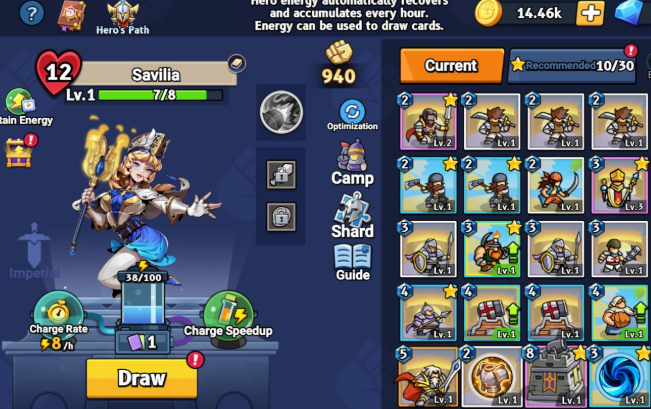
A big early note: the game’s beginner flow pushes you through early content, and you’ll start with Savilla as the default starter hero.
So you can absolutely begin there, learn the rhythm, then pivot into a stronger hero once you understand what your deck is even trying to do.
Early beginner advice that actually works:
Pick a hero whose ability timing you can feel. Turn 1–4 heroes are easier to learn than “turn 6 late swing” heroes at the start.
Don’t chase fancy combos until you can consistently spend your mana each turn.
Prioritize a curve: low-cost units early, medium-cost units midgame, and only a few heavy closers.
VII. Race System & Faction Synergy (The Part That Sounds Confusing But Isn’t)
This game uses a Main Race + Sub-Race system tied to your hero. In deck building, you’re encouraged to stay within your race identity because it’s how you unlock cohesive card pools and consistent synergy.
The core races you’ll see referenced (based on hero race tags and community resources) include:
Imperial
Roughrock
Inferno
Winter God
Pirate Bay
Zen
Mysteria
Nature
How to think about races as a player:
Main race = your “default style”
Sub-race = your “flavor/splash”
Your best decks usually have a strong core plan (main race) plus support tools (sub-race).
Practical synergy examples (not rigid rules, just how it feels in matches):
Imperial tends to feel structured and “honest”: sturdy lines, buffs, control tools.
Inferno often leans aggressive or burn/value-through-damage.
Winter God can feel tempo/control-oriented with board shape tools.
Zen leans into buffs, disruption, and clean midgame transitions.
Pirate Bay tends to feel tempo/value with flexible deployment patterns.
Mysteria often implies spell/utility packages.
Don’t overthink it at first. Build “good cards that fit your curve,” then tighten the synergy later.
VIII. Core Gameplay Mechanics (Mana, Grid, Win Condition)
Here’s the “if you skip this, you’ll lose for dumb reasons” section.
The battlefield is a 9×9 grid
Positioning matters because it decides:
who trades into whom,
how protected your hero-lane becomes,
how easily your units get picked off or surrounded.
Your win condition is hero HP
You win by reducing enemy hero HP to 0. That means:
Trading is only good if it protects your HP or leads to damage.
“Board control” is not a goal by itself—it’s a tool to land damage safely.
Mana pacing is the hidden skill check
Most new players lose because they:
dump their hand early and have nothing later,
or hold cards too long and waste mana (falling behind on board).
A clean “learning rule”:
Spend mana efficiently every turn, even if it’s not perfect.
Consistency beats genius when you’re new.
IX. Deck Building Fundamentals (The 30-Card Rule + Curve Logic)
You need at least 30 cards in your deck.
Now the part nobody wants to hear, but everybody needs:
A deck that “feels good” usually has:
Enough early plays so you’re not passing turns,
Enough midgame weight so you don’t fold to bigger units,
A couple finishers so you can close games instead of stalling forever,
And a few answers (removal, silence, stun, whatever your card pool supports).
The beginner curve that won’t betray you
If you don’t know what you’re doing yet, aim for something like:
10–14 early-cost cards (so you have actions),
10–12 mid-cost cards (your main fights happen here),
4–6 late-cost cards (your closers, not your whole plan).
If your opening hand regularly has “all expensive stuff,” your deck is the problem, not your luck.
X. Card Types, Rarity, and Why Summon Rates Matter
One of the sneaky-important details: heroes have summon chance distributions that influence how often you pull higher-rarity cards. Legendary heroes like Elaine/Chacha/Grattana/Kovicus/Hsi show the same distribution in the tier list reference: 64% Rare, 30% Epic, 6% Legendary (as described in their profiles).
Epic and Rare heroes have different distributions (and also lower HP baselines in the examples), which changes how consistent your deck’s “power cards” show up.
Translation in player language:
Better heroes don’t just have better abilities.
They often also make your deck’s top-end feel more reliable over time.
XI. Special Mechanics & Keyword Play (How You Actually Win Trades)
You’ll see mechanics like:
Trample (overflow damage through units),
Silence (turn off annoying effects),
Pushback / displacement (mess with formation),
Statuses like “Suspend” or “Defender” referenced in hero abilities.
The important thing isn’t memorizing every keyword—it's learning what they do to the tempo.
Example: why Trample is scary (Chacha)
It turns “I traded” into “I traded and still hit your face.”
It pressures hero HP while staying on board.
Example: why pushback is underrated (Hsi)
It’s not just displacement—it breaks defensive geometry.
And it often opens a lane for damage.
XII. Campaign Mode & Progression (How the Game Feeds You Resources)
If you’re playing early progression, campaign matters because:
It’s structured, it teaches basics, and it unlocks systems.
Also, Energy is a core currency—used for things like hero progression and other upgrades, and you’ll repeatedly earn it through normal play loops like battles and quests.
Practical advice:
Don’t hoard everything forever. Early upgrades help you win more, and winning more accelerates everything else.
But also don’t blow premium resources randomly when you don’t even know your preferred race style yet.
XIII. Resource Management (Energy, Gold, Diamonds — The “Don’t Brick Your Account” Part)
Here’s the simple player rule:
Spend resources to increase consistency, not to chase fantasy pulls.
Early on, consistency comes from:
A stable hero choice,
A smooth deck curve,
And having enough basic cards upgraded that you aren’t losing to fundamentals.
If you’re F2P (or low-spend), your biggest advantage is discipline:
Pick a direction (one hero + one race identity),
Build it properly,
Then expand later.
XIV. Quest & Event Systems (How You Actually Farm)
As you progress, systems like quests unlock and become repeatable resource sources, which is typical for mobile CCG loops.
What you should do as a player:
Prioritize recurring quests (daily/weekly equivalents) because they smooth out resource income.
Use events to patch weaknesses (if you need cards, target card rewards; if you need upgrades, target upgrade mats).
XV. PvP / Ranked Mindset (How to Stop Throwing Games)
Ranked losses usually come from one of these:
Bad curve (you passed too much early)
Bad placement (you gave free trades or opened a lane)
Overcommitting (you dumped your hand into an obvious punish)
Not planning around your hero ability turn
So here’s the “stop hemorrhaging ELO” checklist:
Before you end a turn, ask: What does the opponent do next turn that ruins me?
If you’re approaching your hero’s trigger turn, ask: Do I need to protect a board for it, or just survive?
If you’re ahead, ask: How do I win safely instead of stylishly?
Stylish wins are for highlight clips. Safe wins are for climbing.
XVI. Advanced Strategy (Tempo vs Value, Lane Control, and “When to Go Face”)
This is where you start to feel like you’re actually playing the game instead of reacting.
Tempo decks
Want early board and continuous pressure.
Love heroes like Kovicus (turn 2 summon) and Thelma (turn 1 drain + unit).
Midrange decks
Fight for board early, then win midgame with better bodies and buffs.
Love heroes like Chacha (turn 4 buff + Trample) and White Saint (turn 5 team buff).
Value/control decks
Survive early, then swing hard late with abilities and bigger resources.
Love heroes like Elaine (turn 6 damage + heal) or even Euryale if built well.
And the most important advanced rule:
Go face when it’s safe and meaningful.
If you can hit hero HP while keeping your board from collapsing, do it. HP pressure forces mistakes.
XVII. Gacha / Summoning Strategy (When to Pull vs When to Chill)
If you’re trying to be efficient:
Pull when you can commit to the hero you get.
Don’t pull “just because you can” if you don’t have enough support cards to build a coherent deck.
From the tier list info, you can see that heroes differ in HP and card summon distributions, which impacts long-term consistency.
So a strong hero isn’t only about the ability—it’s also about how the hero supports your deck quality over time.
XVIII. FAQ (Real Player Questions)
“Which hero should I pick first if I want to climb?”
If you want a clean meta start: Elaine if you like late swing/control, Kovicus if you like early tempo, or Chacha if you like board-based midrange pressure.
“Is A-tier good enough?”
Absolutely. A-tier heroes are strong—you just need tighter deck building and fewer autopilot mistakes.
“What’s the minimum deck size?”
30 cards minimum.
“How do I stop losing to ‘bad draws’?”
90% of “bad draw” complaints are actually:
too many high-cost cards,
not enough early plays,
or poor mulligan/early placement.
Fix your curve first.
“Do paid heroes crush F2P?”
Strong heroes help, sure, but this game rewards fundamentals a lot:
placement,
tempo,
and planning around turn-based ability triggers.
You can absolutely beat stronger collections with better decisions.
If you’re here for the quick takeaway, it’s this:
S-Tier is S-Tier for a reason: Elaine, Chacha, Grattana, Kovicus, and Hsi give you strong, timed power spikes that are easy to build around and hard to play against.
A-Tier is underrated: Thelma and White Saint can absolutely carry games if you build properly and don’t throw your curve into the trash.
B-Tier is still playable, but you’re choosing “hard mode” unless you specifically want those niche mechanics.
The game is a grid-based CCG where fundamentals matter: 30-card decks, 9×9 positioning, mana pacing, and hero ability timing are your real win conditions.
If you want my “player-to-player” recommendation:
Pick one S-tier hero whose ability timing fits your personality, build a clean deck curve, and grind matches until you can predict turns instead of reacting to them. That’s when the game stops feeling random and starts feeling like you’re the one in control.
And once you hit that point? Yeah. This game becomes ridiculously satisfying.