Crashlands 2s: The Player’s “I Can’t Stop Crafting” Survival Guide (Weapons, Builds, Exploration, and Why Woanope Eats Your Free Time)
If you searched “Crashlands 2s”, you’re probably in one of two moods:
you loved the original Crashlands and you’re wondering if the sequel still has that goofy “quest → craft → bonk aliens → craft more” loop, or
you just started Crashlands 2 and you’re already buried under 37 tracked recipes, 12 new materials, and one particularly disrespectful creature that keeps sending you back to your D.E.D. like it’s a part-time job.
Either way—welcome. This is a player-style, practical, “here’s what actually matters” guide. I’m going to walk through the core systems, weapons, loadouts, armor + infusions, progression milestones, and the stuff the game doesn’t scream at you but absolutely expects you to figure out.
First, the basics: Crashlands 2 is the crafting-action RPG sequel from Butterscotch Shenanigans. It launches (and yes, it’s real) on April 10, 2025, and it’s available on PC (Steam) plus iOS (App Store) and Android (Google Play). It also supports cross-platform save syncing, which is the fancy way of saying “I can play on PC, then continue on my phone when I’m pretending to be productive.”
Now the vibe: you play as Flux (space trucker, professional problem magnet), and you’ve got Juicebox along for the ride. You crash-land on Woanope, a planet that looks cute for about five minutes until something tries to fold your health bar into origami. The loop is classic Butterscotch: explore weird biomes, meet weirder locals, craft a tool to solve a problem, and then craft five more tools because you got distracted by a shiny rock that turned into a new workstation.
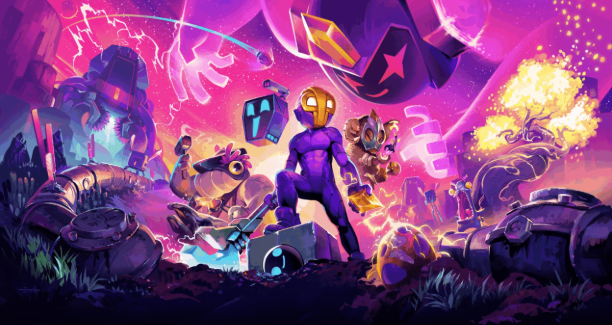
I. Game Overview (What Crashlands 2s Actually Is)
A. What is Crashlands 2?
Crashlands 2 is an open-world-ish crafting action RPG where crafting is progression, not decoration. You don’t craft “because base building is cute.” You craft because the world is constantly asking you questions like:
“Want to cross this hazard?”
“Want to survive that enemy?”
“Want to access this new region?”
And your only valid response is: build something.
The sequel lands after a long gap and modernizes a lot: combat feels more deliberate, weapon variety is way bigger, and exploration is tied to upgrades and collectibles instead of just “walk until you find trouble.” The overall structure is still: Explore → Craft → Fight → Quest → Repeat, but the reason you do each step is better connected than in many crafting RPGs.
B. Platform availability (and the “PC vs console” reality check)
A lot of people assume “sequel = console launch.” But the official availability is Steam + App Store + Google Play (PC + mobile), and the big quality-of-life win is cross-platform save syncing.
Emulator players are still a thing (BlueStacks/LDPlayer/MuMu), but honestly? If you’ve got the Steam version, that’s the cleanest PC experience.
C. Core gameplay loop (the honest version)
Here’s how it plays in real life:
You pick up a quest.
The quest needs an item/tool.
The item/tool needs 2–5 materials you don’t have.
You go explore.
Exploration triggers combat.
Combat drops materials.
You craft the thing… and then notice you’re now one ingredient away from crafting an even better thing.
You forget the original quest and become a crafting gremlin.
That’s not a complaint. That’s the game. If you like this kind of “productive chaos,” Crashlands 2 is basically a buffet.
D. Protagonist team: Flux + Juicebox
Flux is your main character. Juicebox is your companion and narrative anchor, and the relationship matters because Crashlands games always lean into humor + heart. Even when you’re min-maxing infusions like a spreadsheet goblin, the game still tries to make you care about the people (and… creatures?) you meet.
E. The setting: Woanope and its biomes
Woanope is built around “different regions feel different,” not just visually but mechanically: enemies behave differently, resources change, and traversal tools matter. The planet is packed with weird flora, weird fauna, and weird social problems you get dragged into because you’re the only one willing to craft a bridge at 2 a.m.
F. The loop scales in complexity (why the game doesn’t get stale fast)
At first, you craft to survive.
Mid-game, you craft to optimize.
Late-game, you craft to specialize: loadouts, infusion tuning, weapon swaps, boss prep, collectible hunting, and completionist goals.
The game stays interesting because it keeps giving you new reasons to care about systems you already learned.
II. Game Mechanics & Core Systems (Where Your Power Actually Comes From)
A. Crafting system (your real “leveling”)
Crashlands 2’s crafting isn’t a side activity. It’s your gear progression, your traversal progression, your base progression, and your “I refuse to walk that far again” progression.
1) Base building as a functional hub
Early on, your base (starting hub) isn’t about aesthetics—it’s about reducing friction:
putting workstations near each other so you stop sprinting back and forth,
placing tiles/paths so navigation isn’t annoying,
building structures that let you cross hazards without doing a whole detour.
Treat your base like a tool, not a trophy.
2) Recipe tracking is secretly the best feature
Recipe tracking is what turns the game from “brain fog crafting” into “targeted progression.”
My advice: track one main goal + one supportive goal.
Main goal: a weapon upgrade, armor upgrade, or tool needed for story progress
Support goal: something that reduces travel time (bridges/teleport network support) or improves survivability
If you track 9 things at once, you’ll farm everything inefficiently and feel like you did a lot while progressing… not much.
3) Resource farming: don’t grind like it’s an MMO
Crashlands 2 is more “go where the quest naturally leads” than “farm one spot for 3 hours.”
Rule of thumb:
Early: farm near objectives so you don’t get murdered in new zones
Mid: push into riskier areas for better materials
Late: route your farms around teleporters so you’re always 30 seconds from a crafting loop
4) Tiles, bridges, and navigation builds
The most underrated power spike in crafting games is mobility.
Being able to cross a hazard or shortcut a loop can be worth more than a +5 damage upgrade, because it speeds up everything you do afterward.
5) Workstations define what you can craft
Crashlands 2 uses workstation access as a gate. When you unlock a new crafting station category, that’s basically the game saying:
“Congrats, you’ve entered the next phase of your build.”
6) Quality tiers: Satisfactory vs Excellent
Crafting quality tiers matter because they’re free value if you pay attention. If you can consistently craft Excellent versions of key items, that’s basically a built-in advantage for boss fights and harder regions.
You don’t need perfection on everything. But you do want it on:
your main weapon(s),
your main armor suit,
any key utility tool you use constantly.
B. Combat mechanics (why button mashing gets punished)
Crashlands 2 combat is real-time and rewards pattern learning. You’ll see telegraphs and warning shapes/colors before attacks, and your job is to respond with movement, spacing, and dodges instead of “stand still and trade.”
1) Jolt (your dodge) is the difference between chill and suffering
If you treat dodging like a panic button, you’ll get clipped.
If you treat dodging like a timed skill (like parry-lite), combat feels clean.
The “Crashlands 2s” mindset: dodge less, dodge smarter.
Learn the enemy’s cadence
Dodge the big hit, not the bait hit
Use positioning so you don’t need to dodge twice in a row
2) Telegraphed attacks are the game’s fairness contract
The game usually tells you what’s coming. If you still get hit, it’s almost always because:
you got greedy,
you locked yourself into an animation,
you fought too many enemies at once,
or you tried to “out DPS” a pattern you haven’t learned yet.
3) Positioning matters more than raw DPS
This is huge. A slower weapon can outperform a faster weapon if you’re consistently landing hits safely.
C. Progression systems (quests + gear + practice)
Progression is a blend of:
quests (main + side),
gear upgrades,
skill development (you learning enemy patterns),
and unlocks (new recipes and regions).
The game’s pacing works best when you do main quest progress, then side quest cleanup, then gear catch-up, then push forward again. If you go full completionist too early, you’ll overfarm low-tier mats and feel weirdly underpowered later because you didn’t push unlocks.
III. Weapon Types & Combat Loadouts (What Each Weapon Feels Like)
Crashlands 2 expands weapon identity hard. The key isn’t “which is best”—it’s “which fits how you move.”
A. Dagger (beginner-friendly, movement-first)
The dagger is the “default good” weapon:
fast attacks,
forgiving timing,
great for exploration because you stay mobile,
easy to learn enemy patterns without getting stuck mid-swing.
When it shines: early game, learning zones, dealing with fast enemies, traveling while still being combat-ready.
Where it struggles: big single-target damage checks (unless your build supports it).
If you’re new, dagger is the safest “learn the game” choice.
B. Spear (ranged safety, but resource hungry)
Thrown weapons are powerful because distance = safety.
But the cost is management: you have to keep supply, and you’re investing materials into “ammo.”
When it shines: enemies with scary melee punishment, bosses with dangerous contact windows, fights where positioning is awkward.
Where it struggles: if you forget to keep crafting spears and suddenly you’re throwing sadness instead of damage.
Spear becomes way better when your build supports recovery/efficiency (like a thrift-style synergy).
C. Crusher (heavy hitter, timing discipline)
Crusher is the “land one meaningful hit” weapon class.
It’s slower, it punishes greed, but it can delete chunks of HP if you play patiently.
When it shines: bosses, tanky enemies, “one big window” fights.
Where it struggles: swarms and fast enemies that punish long wind-ups.
Crusher players need one skill: stop swinging early. Swing when the opening is real, not when you wish it was real.
D. Knuckles (close-range adrenaline)
Knuckles are for people who like living on the edge.
Fast hits, high uptime… but you have to stay close, and that means you’re playing dodge + spacing constantly.
When it shines: if you can read patterns and stay glued to targets safely.
Where it struggles: if you panic or overcommit, because being close removes your margin for error.
Knuckles feel amazing when you’re in flow. They feel awful when you’re learning.
E. Gadget weapons (weird, strong, cooldown-based)
Gadget weapons are the “special sauce” category:
unique mechanics,
chunky effects,
longer cooldowns.
They’re not always “main weapon” material, but they’re incredible as a secondary tool: a burst option, a utility option, or a fight-specific trick.
If you’re exploring and you see something shiny that looks like it might be a gadget—grab it. Gadget discovery is basically the game rewarding curiosity.
F. Throwables (utility, not your main plan)
Throwables are the “I need a ranged option right now” backup tool early on.
They’re also often crafting ingredients for better ranged weapons.
Use them to:
finish low HP targets safely,
poke enemies while learning patterns,
pull enemies one-by-one (crowd control through patience).
G. Axes (crowd control and multi-hit power)
Axes are the group-fight answer:
slower swings, but wide coverage,
great when enemies cluster,
satisfying when you position well.
When it shines: grouped enemies, corridor fights, “I want to hit three things at once.”
Where it struggles: if enemies are spread out and mobile.
Axes reward positioning more than reflexes.
IV. Weapon Selection Strategy & Loadout Optimization (How to Stop Dying and Start Feeling Strong)
A. Early-game loadout (first 2–3 hours)
Early game is about survival + exploration, not damage flexing.
My favorite early structure:
Primary: dagger (reliable, safe)
Secondary: throwables (backup ranged)
Utility: traversal/build items as soon as you can craft them
The early game trap is thinking you need to “farm power.” You don’t. You need to unlock tools that let you reach better materials and safer routes.
B. Mid-game loadout (3–8 hours)
Mid-game is where you diversify for encounter variety:
keep your dagger or swap to crusher if you like boss punching,
bring spear if you’re tired of taking hits you didn’t earn,
add a gadget if you find one that fits your style.
Mid-game is also where you should start thinking:
“Which weapon do I want to master?”
Because mastery is a bigger power spike than switching weapons every 10 minutes.
C. Late-game loadout (8+ hours)
Late-game is specialization and prep:
one “comfort weapon” you trust,
one “boss weapon” that solves big threats,
one “utility weapon” that helps in weird fights (gadget/axe/spear depending on your style).
D. Loadout swapping (why multiple sets matter)
If the game lets you save multiple equipment configurations, it’s not a gimmick. It’s a permission slip to stop forcing one build to solve every problem.
Have:
an exploration set (speed + sustain),
a boss set (damage + defense),
a crowd set (AoE + survivability),
a “risk zone” set (defensive infusions + safe weapon).
Swapping loadouts should feel like changing tools, not changing identity.
V. Armor & Infusion System (Where Builds Are Actually Made)
A. Your main armor suit and quality tiers
Armor progression is straightforward: craft better, upgrade quality when you can, and treat armor like your “permission” to enter harder areas.
If you keep getting two-shot, it’s not always “skill issue.” Sometimes it’s “you walked into a zone meant for better gear.”
B. Infusion system (stat customization that actually matters)
Infusions are the build system. This is where you decide:
do I want to move faster?
do I want sustain?
do I want tankiness?
do I want burst?
A simple way to think about it:
Mobility infusion = fewer hits taken, faster exploration
Regen/sustain infusion = more mistakes allowed
Defense infusion = safer learning curve
Offense infusion = faster clears, but riskier if you’re sloppy
Early recommendation: don’t go full glass cannon until you know patterns.
C. Equipment quality: when to chase “Excellent”
Chase excellent crafting on:
armor,
your main weapon,
your “boss answer” weapon.
Everything else can be satisfactory until you’re stable.
D. Stat priorities that actually feel good
A “feels good” build usually has at least one of:
movement speed,
passive health regen,
damage reduction.
Pure damage builds are fun… right up until you get clipped twice and spend 3 minutes retrieving your stuff.
VI. Crafting Deep Dive & Resource Management (Stop Hoarding Random Junk)
A. Recipe discovery and unlock pacing
New recipes are a progression reward. If you feel stuck, it’s often because you need to:
progress the story,
meet a new NPC/creature group,
or explore a new biome that unlocks new materials.
B. Base building: expand incrementally
Don’t overbuild early. Expand when you have a reason:
new workstation category,
new traversal need,
farming route you want to streamline.
A base should evolve with your needs, not inflate your chores.
C. Resource gathering strategy that saves time
Farm close early.
Farm smart mid-game (teleporters).
Farm dangerous late-game (high-value mats).
Also: if resources respawn, treat zones like “routes,” not “spots.” Build a route, run it, craft, repeat.
D. Recipe tracking optimization
Tracking is how you stop wandering. Use it like a GPS for progression. If you ever catch yourself thinking, “What was I even doing?”—you tracked too much, or you tracked nothing.
VII. Combat Guide & Enemy Patterns (How to Win Without Sweating)
A. Enemy behavior: learn the “shape language”
Enemies telegraph. Your job is to learn what each telegraph means:
is it a lunge?
a slam?
a multi-hit combo?
an AoE?
Once you recognize the pattern, the fight becomes chill.
B. Combat fundamentals (that keep you alive)
Dodge the real hit, not the bait
Don’t fight five enemies just because they’re nearby
Use terrain to isolate targets
Switch weapons if the matchup feels bad
Take a breath—seriously, panic is the #1 DPS loss
C. Advanced tactics (when the game gets spicy)
bait enemies into open space so dodging is easier
split groups: pull one enemy, retreat, repeat
treat boss fights like rhythm games: hit on beat, dodge on beat
don’t “trade” unless your build is meant to trade
VIII. Exploration & Map Navigation (The Part Where You Either Save Hours or Lose Them)
A. World structure and why biomes matter
Biomes are not just art. They’re:
new material pools,
new enemy patterns,
new crafting branches.
Exploration is progression because it unlocks options.
B. Navigation tools: teleporters and traversal builds
Activate teleporters the moment you see them.
Do not be the person who “will come back later” and then runs 12 minutes across the map to craft one thing.
Traversal builds (bridges/tiles/etc.) are also progression. If a tool makes movement easier, it pays itself back.
C. Exploration benefits beyond resources
Exploration gets you:
collectibles,
upgrades,
pets/companions (depending on what you find),
side quests that unlock recipes,
and “oh wow this is useful” gadget weapons.
D. Exploration hazards (the part you respect)
If you keep dying in a region:
your gear might be behind,
your infusion choices might be too aggressive,
or you’re pulling too many enemies.
Sometimes the correct strategy is: leave, craft, come back stronger.
IX. Juice Gems & Collectible Progression (Min-Max Fuel)
Collectibles that power upgrades are always important, because they’re limited and permanent. If you have a system like this, your best move is:
spend early on universal value (speed/sustain),
mid-game specialize a little,
late-game min-max for boss fights or challenge areas.
Don’t dump everything into damage at the start unless you like living dangerously.
X. Game Progression & Questline Structure (How the Story Actually Moves)
A. Main story progression
Crashlands 2 uses main quests to push you into:
new regions,
new NPCs,
new crafting tiers.
If you hard-stall on story, it usually means you ignored a crafting gate.
B. Quest types and how to use them
Main quests: unlock systems
Side quests: give useful rewards and recipes
Affinity/relationship quests: often unlock unique crafting or story advantages
A good pacing strategy:
push main story until you hit a difficulty wall,
do side quests to gear up,
return and break through.
C. Creature befriending and why it matters
Crashlands games love “friendship as progression.” Even if you only care about gear, interacting with factions/creatures can unlock tools and recipes that make the entire mid-game smoother.
D. Pet/companion system (if you’re a collector brain)
If the game gives you pets/companions via eggs or exploration, treat them like bonuses. Don’t stress them early—just keep an eye out and enjoy the surprise factor.
XI. D.E.D. System & Death Mechanics (The “You Messed Up” But Not Punishing System)
The D.E.D. system is basically the game saying:
“Yeah, you died. Go pick up your stuff. Learn something.”
A. Why it’s good design
Death costs time, not your entire run. That makes experimentation viable:
test a new weapon,
push a dangerous zone,
learn a boss pattern.
B. How to retrieve safely (so you don’t chain-die)
teleport near it if possible
lure enemies away first
approach during enemy cooldown windows
don’t rush in with 2 HP and optimism
C. “Death as learning”
In crafting RPGs, death is often part of the loop. Crashlands 2 makes it tolerable, which is a huge reason the game feels friendly instead of oppressive.
XII. Equipment Variety & Playstyle Diversity (There’s No One “Correct” Build)
A lot of players get stuck chasing “the best weapon.” In Crashlands 2, the best weapon is the one you can consistently land hits with without getting hit back.
Aggressive players: knuckles/daggers
Patient hitters: crusher/axe
Safe strategists: spear + gadget support
Hybrid enjoyers: mixed loadouts with quick swaps
The game rewards mastery, not just gear.
XIII. Early-Game Milestones (Do These and You’ll Feel Stable Fast)
A. Tutorial phase: don’t speedrun it blind
Pay attention to:
dodge timing,
telegraph visuals,
crafting menu structure,
recipe tracking.
B. First 1–2 hours: build your hub, unlock your tools
Your priority is unlocking:
core workstations,
basic traversal options,
a consistent weapon upgrade path.
C. Survival fundamentals checklist
learn one enemy pattern at a time
don’t fight groups unless you must
craft the next dagger/crusher tier when available
activate teleporters immediately
invest early infusions into movement/sustain
D. First expansion steps
Once you’re stable:
branch into a second weapon type,
start building routes,
hunt for gadgets,
and push into the next biome for better mats.
XIV. Mid-Game Expansion (Where the Game Opens Up)
Mid-game is where:
your crafting list becomes a lifestyle,
your weapon mastery starts paying off,
and you stop feeling fragile.
You’ll start juggling multiple projects:
upgrading armor,
upgrading weapons,
expanding base,
collecting infusion materials,
exploring new zones.
This is the phase where organization saves your sanity.
XV. Late-Game and Endgame (Optimization, Not Just Survival)
Late-game is about:
refining loadouts,
optimizing infusions,
completing affinity chains,
tackling harder optional fights,
and going full completionist if that’s your thing.
Endgame in crafting RPGs is often “self-directed goals.” If you like set objectives, chase all collectibles and max upgrades. If you like combat mastery, do challenge runs or boss rematches with off-meta weapons.
XVI. Troubleshooting Common Issues (The Stuff That Gets People Stuck)
A. “I don’t have enough resources”
You’re probably farming the wrong biome. Push forward, unlock better nodes, then route your farm with teleporters.
B. “Combat is suddenly too hard”
upgrade armor/weapon tier
switch weapon type for matchup
adjust infusions (more sustain/defense)
slow down and learn patterns
C. “Progression bottleneck”
If story progress stalls, it’s usually a crafting gate. Track the required recipe, then treat it as your main goal until it’s done.
D. “Navigation is annoying”
That’s a teleporter/traversal problem. Activate more teleporters. Build more shortcuts. Mobility is power.
XVII. Beginner Tips & Quality-of-Life Tricks (The “I Wish I Knew This Earlier” Section)
Stay close to objectives early—distant farming is bait.
Track recipes—your brain will thank you.
Invest in speed or regen early—it makes everything smoother.
Use weapon swaps—don’t force one tool to solve all fights.
Activate teleporters immediately—future you will love present you.
XVIII. Crashlands 2 vs the Original (What Feels Different)
The sequel modernizes without losing the identity:
more weapon variety,
more deliberate combat,
stronger exploration incentives,
deeper build customization.
It still has that Butterscotch humor and “everyone is weird but lovable” energy, but the systems feel sharper and more flexible.
XIX. Community Resources & External Guides (Where Players Usually Hang Out)
If you want maps, collectible routes, or min-max builds, the best non–Mainland China hubs are usually:
official dev posts/announcements,
Steam community discussions,
Discord communities,
and western gaming guides.
Also, if you’re curious about the tech side: there are developer-focused writeups/interviews about how Crashlands 2 was built and shipped cross-platform.
XX. Final Recommendations (How to Actually Enjoy Crashlands 2s Without Burning Out)
A. Key takeaways
Crashlands 2 is a crafting action RPG where crafting = progression.
It launches April 10, 2025 on PC + iOS + Android, with cross-platform save syncing.
Weapons are playstyle tools, not strict tier lists—mastery beats “best weapon.”
Recipe tracking + teleporters are the two biggest time savers.
Infusions/build tuning are where late-game power really comes from.
B. Getting started recommendations (the fast path)
Finish the intro and get your hub stable.
Pick one weapon type to “main” and one to “solve problems.”
Invest early into speed/sustain so exploration stops feeling punishing.
Activate teleporters the moment you find them.
Push story until you hit resistance, then side-quest + craft your way through.
C. Progression strategy (simple and effective)
Early: survive + unlock tools
Mid: diversify + organize crafting goals
Late: specialize + optimize loadouts/infusions
Endgame: completionist goals or challenge runs—your call
D. Playstyle matching (pick your “vibe”)
Want fast flow? Dagger/knuckles.
Want chunky hits? Crusher/axes.
Want safer fights? Spear + gadget support.
Want flexibility? Multiple saved loadouts and fast swapping.
If you’re here for Crashlands 2s because you want the short verdict: it’s a sequel that understands why people loved the original loop, then upgrades the parts that needed more depth—combat readability, weapon identity, build customization, and exploration payoff. It’s still goofy, still craft-happy, still packed with “I’ll just do one more quest” traps… but now it’s also a lot better at letting you play your way.
My final player advice: don’t rush the fun out of it by obsessing over perfect efficiency on day one. Get stable, pick a weapon that feels good, invest in movement/sustain early, and let the game’s crafting ecosystem pull you forward naturally.
And when Woanope inevitably smacks you down and sends you back to your D.E.D.? Don’t tilt. Grab your stuff, craft something slightly better, and come back with revenge in your inventory.